
Stafford County Court Records After Arrest
After a Stafford County arrest, two record tracks can exist at the same time. The jail or sheriff side deals with custody, booking, release, bond questions, and whether the person is still held at Stafford County Jail. The court side begins when a complaint, information, indictment, citation, or other charging paper is filed in district court. That filed case is where court records after a jail arrest become useful, because the docket can show the charge list, hearing dates, bond orders, warrants, dispositions, and other entries tied to the case.
The Stafford County Attorney is Mike Robinson. The official county page describes the office as the chief law-enforcement office for Stafford County and says it handles felony crimes, selected misdemeanors and traffic prosecutions, juvenile matters, care and treatment cases, criminal appeals, and selected traffic offenses. For custody and booking detail, use Stafford County jail inmate records. For booking photos, use Stafford County jail mugshots. Court records after an arrest are different because they follow the charge filed with the court, not just the arrest event.
The official Stafford County Clerk of District Court page places the county in the 20th Judicial District with Ellsworth, Rice, Russell, and Barton counties. The clerk is the local court-record contact for filed cases in St. John. When a case is too new for the statewide portal, sealed from public view, or difficult to match by name, the clerk can explain what public records may be searched and what must be requested at the counter.
The Stafford County Attorney image from the official county attorney page matches the prosecution role behind filed charges after an arrest.
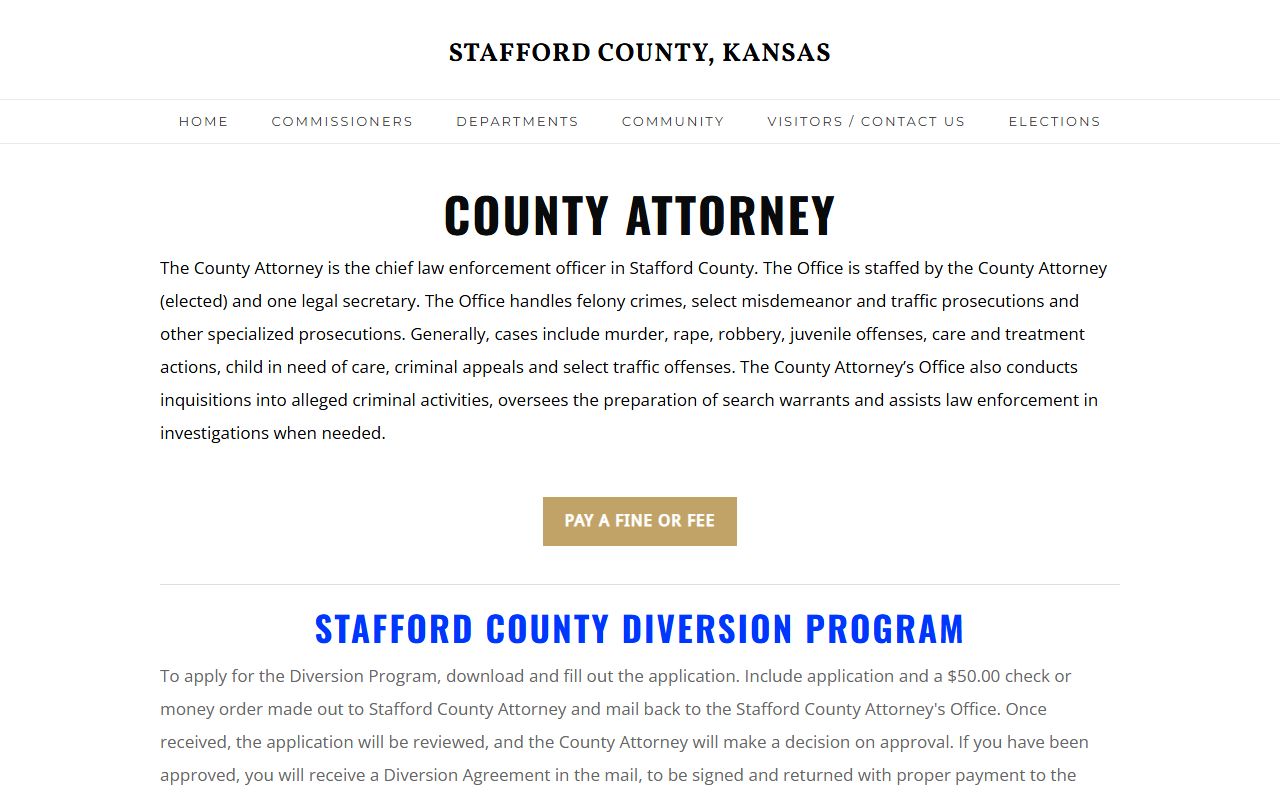
That office context matters because booking allegations may change before formal court charges are filed.
Find Stafford County Court Records
The main statewide search route is Kansas Case Search, the Kansas Judicial Branch portal for district court records. The research found that the portal supports searches by case number, party name, business name, citation, and other role-based criteria. For Stafford County court records after a jail arrest, a defendant name search is often the starting point when the case number is unknown. A citation search may help for traffic or citation-based matters.
- Confirm the custody question first. If the issue is whether someone is in jail today, call Stafford County Sheriff / Communications before relying on a court docket.
- Search Kansas Case Search by party name, case number, or citation. Use exact spelling when known, but try common name variants if the first search fails.
- Open the Stafford County criminal case result and review the charge list, filing date, bond entries, hearing settings, and current status.
- If no result appears, contact the Stafford County Clerk of District Court. New filings, restricted records, sealed cases, and name mismatches may not be clear from a public portal search.
The Kansas Case Search portal screenshot from the manifest is the most direct image match for this page.
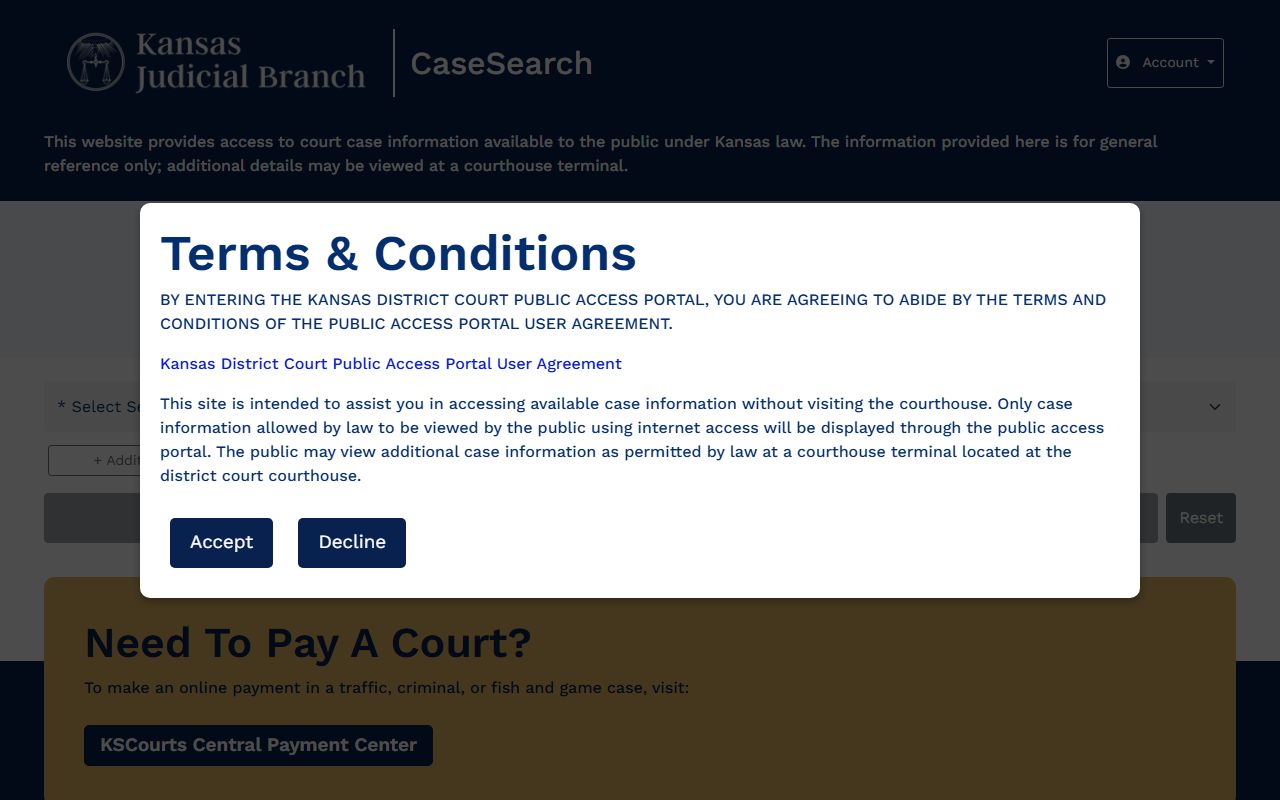
The portal is for filed court cases. It is not an online Stafford County jail roster and does not replace a call to the sheriff for current custody.
For broader statewide criminal history, the Kansas Bureau of Investigation provides a fee-based record check, but that system is not a live jail roster or a court docket. It can be useful when the goal is a statewide criminal-history record rather than a single Stafford County case. Court records after an arrest should still be checked against the originating case and the clerk because public criminal-history summaries may not show every docket event or pending change.
Stafford County Case Search Fields
Kansas Case Search gives several routes into Stafford County court records after a jail arrest. Use the best known identifier first. A case number is the cleanest match when it appears on a citation, bond paper, summons, or court notice. A party-name search is more common for family members who only know the person's name after an arrest. Citation searches can help when the charge began as a ticket or traffic stop.
| Field Label | Type | Required | Notes |
|---|---|---|---|
| Case number | Search criterion | No | Use when the number appears on a citation, complaint, bond form, or court notice. |
| Party name | Search criterion | No | Useful for defendant-name searches in criminal cases after arrest. |
| Business name | Search criterion | No | More common for civil or business-party records than jail-arrest matters. |
| Citation | Search criterion | No | Useful for traffic and citation-based criminal cases. |
| Other role-based criteria | Role-based | Varies | Some options may depend on public-user access or court-user role. |
Search results can lag behind a very recent booking. If a person was arrested in Stafford County and no case appears yet, the matter may still be in the booking, charging, or first-appearance stage. The safest sequence is sheriff for custody, Kansas Case Search for filed charges, and the clerk for unresolved record questions.
Charges Filed After an Arrest
The court record starts with a charging document. A booking entry reflects the arresting agency's early allegation, warrant, or hold. The filed court charge reflects what the prosecutor or grand jury placed before the court. That is why Stafford County court records after a jail arrest can show a different charge level, a different count list, or a narrower case than the first booking notes suggested.
| Document | Who Files It | What It Does |
|---|---|---|
| Complaint | Often prepared through law enforcement and prosecution | Starts many criminal cases and states the alleged offense for court action. |
| Information | Prosecutor | Sets out formal charges, often in felony or prosecutor-filed cases. |
| Indictment | Grand jury | Charges a case through grand-jury action rather than a standard complaint path. |
The County Attorney page says the office also conducts inquisitions, oversees search-warrant preparation, and assists law enforcement investigations. Those duties help explain why an arrest and a court charge can develop on different timelines. A person may be booked quickly, but the filed court record depends on the charging decision and court processing.
Stafford County Charge Status
Charge status is the current legal posture of a filed count. A status is not the same thing as a conviction. It can change after review by the Stafford County Attorney, negotiation, preliminary hearing, trial, diversion review, or dismissal. Read each count on the docket, because one charge may be pending while another has been amended or dismissed.
| Status | What It Means |
|---|---|
| Pending | The charge remains open and has not reached final disposition. |
| Amended | The filed charge was changed, often to a different count, level, or wording. |
| Reduced | The charge level or offense was lowered from an earlier version. |
| Dismissed | The court record shows the charge was ended without a conviction on that count. |
| Disposed | The count has reached an outcome, such as plea, verdict, dismissal, or other final action. |
Note: A jail booking charge is an early custody record. The court charge is the filed accusation that the case tracks.
Bond After Stafford County Arrest
Stafford County did not publish a jail bond payment page in the official online materials reviewed. After an arrest, the practical local path is to ask Stafford County Sheriff / Communications whether bond is set, whether the person has a no-bond hold, where payment is accepted, and whether payment belongs at the jail, court, or through a bonding company. Once a case is filed, bond conditions may also appear in Kansas Case Search or may be confirmed through the clerk.
| Bond Type | How It Works |
|---|---|
| Cash bond | The full amount is paid in cash or another form accepted by the jail or court. |
| Surety bond | A licensed bail agent posts bond for a fee and may require conditions. |
| Personal recognizance | Release is based on a written promise to appear and comply with conditions. |
| Property bond | Property may be pledged if the court permits that form of bond. |
| No-bond hold | Release is blocked until a judge or holding agency changes the hold. |
Holds can come from another Kansas county, a municipal case, probation or parole, KDOC, federal authorities, the U.S. Marshals Service, ICE, or a court order requiring appearance before a judge. A detainer is a request or hold from another agency. It can keep someone in custody even when the local Stafford County bond issue looks resolved.
Warrants and Court Records
No official Stafford County active-warrant search or most-wanted page was located. That does not mean warrants cannot exist. It means the public path is not a county warrant database. For warrant-related court records after a jail arrest, use Kansas Case Search for filed cases, call the Stafford County Sheriff's Office for custody or warrant questions, and contact the Clerk of District Court for case-specific bench warrant questions.
- Arrest warrant
- A judge-authorized custody order tied to an alleged crime.
- Bench warrant
- A court order often issued after a missed hearing or failure to comply.
- Search warrant
- A court order to search a place or item, not a custody roster.
- Fugitive or hold warrant
- A warrant or hold from another jurisdiction that may require transfer.
Clearing a warrant is not the same as being removed from a list. The person may need a court appearance, bond review, counsel, or action in another jurisdiction. The issuing court, sheriff, or an attorney is the proper source for next steps.
Charges vs Convictions
Stafford County court records after an arrest may show charges long before a conviction exists. A charge is an accusation filed in court. A conviction is an outcome after a plea, verdict, or other final disposition that counts as guilt under the case record. Treat the terms with care when reading a docket or a statewide criminal-history result.
| Issue | Charge | Conviction |
|---|---|---|
| Stage | Filed accusation after arrest or citation | Final guilty result by plea, verdict, or court action |
| Proof | Based on probable cause or charging decision | Requires proof, plea, or adjudicated outcome |
| Record use | May appear on public docket while pending | May appear on docket and criminal-history records |
| Can change | May be amended, reduced, or dismissed | Can be affected by appeal, expungement, or other court order |
Sealed and Expunged Records
Kansas law includes an expungement process for certain convictions, arrest records, and diversion agreements. The research source for this topic is K.S.A. 21-6614. Expungement does not mean every record disappears from every internal government system, and eligibility depends on the case type, disposition, waiting period, and court order. For Stafford County court records after an arrest, the clerk is the local source for the existence and public effect of an expungement order.
| Issue | Sealed or Restricted | Expunged |
|---|---|---|
| Public view | Hidden or limited by court rule, statute, or order | Removed from ordinary public access after a qualifying order |
| How it happens | May arise from juvenile status, court order, or confidentiality rule | Requires eligibility and court action under Kansas law |
| Agency access | Some justice agencies may retain limited access | Some official uses may remain allowed by statute or order |
| Best contact | Clerk of District Court for the case | Clerk of District Court or legal counsel for filing and effect |
Note: Juvenile records, sealed matters, active investigations, and court-restricted documents may not appear in public search results.
Kansas Public Records Rules
The Kansas Open Records Act starts at K.S.A. 45-215, and K.S.A. 45-217 defines public-record terms. The research notes that annotations to the definitions section reference law-enforcement records, jail books, standard offense reports, and mug shots. For court records after an arrest, that public-record framework does not override every limit. Agencies may still apply exemptions, redactions, sealing orders, juvenile confidentiality, or active-investigation limits.
The Kansas Open Records Act title statute screenshot fits the public-access issue behind Stafford County arrest and court records.
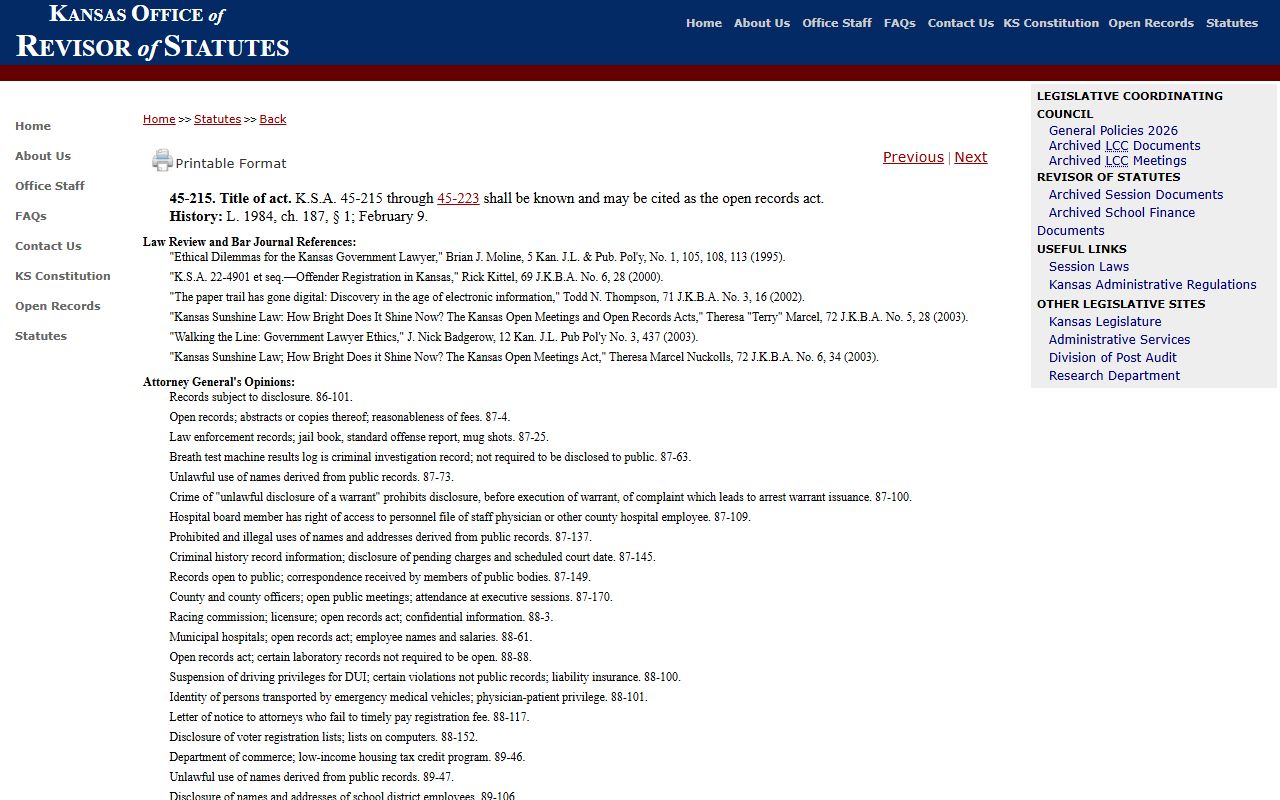
KORA can support a request path, but it does not guarantee that each requested court, jail, or law-enforcement item will be released without limits.
Important: Public-record lookup information is not a consumer report and cannot be used for credit, employment, housing, insurance, or other FCRA-covered decisions.
Stafford County Court Contacts
Use the agency that owns the question. Current custody, release, and jail booking questions belong with Stafford County Sheriff / Communications. Filed criminal case questions belong with the Stafford County Clerk of District Court. Charging-policy or diversion questions may involve the Stafford County Attorney, though the prosecutor's office is not a public case-status help desk for every inquiry.
Stafford County Clerk of District Court
209 North Broadway, 3rd Floor
St. John, KS 67576
(620) 549-3295
8:00 a.m. to 5:00 p.m. Monday-Friday
Stafford County Attorney
209 North Broadway
St. John, KS 67576
(620) 549-3501
8:00 a.m.-12:00 p.m. and 1:00 p.m.-5:00 p.m. Monday-Friday